2018 is going to be an exciting year for this indie (independent) author. Think: acting a fool level of excitement.
I recently decided to self-publish my debut nonfiction book on love and modern medicine: Memoirs of a Surgeon’s Wife: I’m Throwing Your Damn Pager into the Ocean. And it’s going to happen in the next couple of months! Happy dance!
Although I have written and published a business writing advice book, available free on Amazon, this will be my first self-published full-length nonfiction book.
One of the coolest things about being an indie author is that you maintain creative control over the whole shebang, including the book title and the cover art.
I’m no professional artist or graphic designer, but I have taken art and photography classes and have a decent artistic eye [pats self on back].
Although I have written and published a business writing advice book, available free on Amazon, this will be my first self-published full-length nonfiction book.
One of the coolest things about being an indie author is that you maintain creative control over the whole shebang, including the book title and the cover art.
I’m no professional artist or graphic designer, but I have taken art and photography classes and have a decent artistic eye [pats self on back].
Since this book is kinda my baby, aside from my actual baby (who is no longer a baby, as she frequently reminds me), it’s important for me to get it right.
I’ll be working with a friend who is a graphic designer on the book cover design, but I wanted to come to her with several ideas and concepts to get the ball rolling.
So, for any other indie authors, self-publishers or the curious among ye, I’m sharing my process for developing a book cover design concept. You can judge the final result when we have…ahem…the final result: the big book cover reveal!
I’ll be working with a friend who is a graphic designer on the book cover design, but I wanted to come to her with several ideas and concepts to get the ball rolling.
So, for any other indie authors, self-publishers or the curious among ye, I’m sharing my process for developing a book cover design concept. You can judge the final result when we have…ahem…the final result: the big book cover reveal!
Book cover design: How to develop a concept for your indie author book cover
Step 1: Shop around
To know what you like and what you are drawn to, you need to shop around. You can accomplish this this by browsing bookstores or browsing online.
If you choose to browse a bookstore, check out the bestsellers for all genres first. Make note of or discreetly photograph (for your own personal use only, of course) the covers you covet. Then make your way to your book genre’s section and see what grabs you.
I personally started my search online with good old Google. I googled “Best book covers of 2017” and found several curated lists. For me, this was a good starting point.
Step 1: Shop around
To know what you like and what you are drawn to, you need to shop around. You can accomplish this this by browsing bookstores or browsing online.
If you choose to browse a bookstore, check out the bestsellers for all genres first. Make note of or discreetly photograph (for your own personal use only, of course) the covers you covet. Then make your way to your book genre’s section and see what grabs you.
I personally started my search online with good old Google. I googled “Best book covers of 2017” and found several curated lists. For me, this was a good starting point.
Step 2: Create your vision board
Since I chose to go the online route for my initial research, I created a Pinterest board called Book Cover Inspiration, and linked the book covers that had me swooning. I also made short notes on what elements of the book cover I liked (illustration style, colors, typography, etc.).
The board confirmed what types of book covers I’m drawn to and helped me narrow down my favorite styles.
Since I chose to go the online route for my initial research, I created a Pinterest board called Book Cover Inspiration, and linked the book covers that had me swooning. I also made short notes on what elements of the book cover I liked (illustration style, colors, typography, etc.).
The board confirmed what types of book covers I’m drawn to and helped me narrow down my favorite styles.
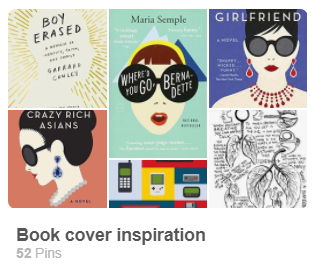
Megan Sharma's book cover inspiration board on Pinterest
Step 3: Consider the heart of your book
Now is the time to ask yourself some questions about your book.
What is the overall tone of the book? What is the message of the book? Why did you write the book? Who is the book’s primary audience? What category does the book belong in?
Since I initially pursued traditional publishing for my book, all these questions were answered in great detail in my nonfiction book proposal.
But I still took the time to think through them and write down succinct answers. This information will also come in handy during the final step.
Now is the time to ask yourself some questions about your book.
What is the overall tone of the book? What is the message of the book? Why did you write the book? Who is the book’s primary audience? What category does the book belong in?
Since I initially pursued traditional publishing for my book, all these questions were answered in great detail in my nonfiction book proposal.
But I still took the time to think through them and write down succinct answers. This information will also come in handy during the final step.

Step 4: Pretend you’re an artist
Once you’ve captured the key tone and message of your book, brainstorm some ideas, then grab a pen and some paper and get to drawing!
I hand-illustrated 12 concepts, hated most of them, and came up with one that I absolutely love.
The process is fun and helps you tap into your creative side.
You can also try a digital mock-up, if you’re so inclined, in Canva. Just pick a template for an e-book cover and get to work.
Once you’ve captured the key tone and message of your book, brainstorm some ideas, then grab a pen and some paper and get to drawing!
I hand-illustrated 12 concepts, hated most of them, and came up with one that I absolutely love.
The process is fun and helps you tap into your creative side.
You can also try a digital mock-up, if you’re so inclined, in Canva. Just pick a template for an e-book cover and get to work.
Step 5: Hand it over to a professional
The importance of a professional-quality, striking book cover cannot be overstated. This is not a job to take on yourself, unless you are a graphic designer or a book cover designer.
Think about it: we all judge books by their covers. It’s not a vanity thing – it helps us determine which books are worth our time and money.
Thankfully in this digital age there are plentiful and affordable options for book cover designers – both for e-books and for print books.
Here are recommended designer resources from authors I trust:
Joanna Penn’s recommendations
Mark Coker’s Smashwords recommendations
I haven’t experienced it yet, but I also intend to give Fiverr’s freelance book designers a try.
The importance of a professional-quality, striking book cover cannot be overstated. This is not a job to take on yourself, unless you are a graphic designer or a book cover designer.
Think about it: we all judge books by their covers. It’s not a vanity thing – it helps us determine which books are worth our time and money.
Thankfully in this digital age there are plentiful and affordable options for book cover designers – both for e-books and for print books.
Here are recommended designer resources from authors I trust:
Joanna Penn’s recommendations
Mark Coker’s Smashwords recommendations
I haven’t experienced it yet, but I also intend to give Fiverr’s freelance book designers a try.
Take these extra steps to conceptualize your book before the professionals jump in. It will help you narrow your vision and improve the ultimate quality of your book.
What book design tips can you share with us? What are your favorite book covers? Leave a comment!
What book design tips can you share with us? What are your favorite book covers? Leave a comment!
You may also like these blogs by Megan Sharma:
BIG NEWS! I’m self-publishing my memoir in 2018. Here’s why…
It's Here! Get My Free E-Book: 100 of Your Toughest Business Emails: Solved on Amazon, Barnes and Noble, iBooks and more
Book preview for When Medicine Meets Holy Matrimony: A word to mothers who aspire to have a surgeon-in-law
Book preview for When Medicine Meets Holy Matrimony: No, I don’t want no scrubs
Book preview for When Medicine Meets Holy Matrimony: For the love of Danskos
Book preview for When Medicine Meets Holy Matrimony: The other shoe
Writing tips: What I want to blog about vs. what I actually blog about
One year after my major career change from full-time mom to full-time writer: reflections and lessons learned
For writers: All your writing fears, squashed!
A real, imperfect day in the life of a writer: me
Your writing conference checklist: how to make it worth every minute and every penny (takeaways from the 2017 San Francisco Writers Conference)
BIG NEWS! I’m self-publishing my memoir in 2018. Here’s why…
It's Here! Get My Free E-Book: 100 of Your Toughest Business Emails: Solved on Amazon, Barnes and Noble, iBooks and more
Book preview for When Medicine Meets Holy Matrimony: A word to mothers who aspire to have a surgeon-in-law
Book preview for When Medicine Meets Holy Matrimony: No, I don’t want no scrubs
Book preview for When Medicine Meets Holy Matrimony: For the love of Danskos
Book preview for When Medicine Meets Holy Matrimony: The other shoe
Writing tips: What I want to blog about vs. what I actually blog about
One year after my major career change from full-time mom to full-time writer: reflections and lessons learned
For writers: All your writing fears, squashed!
A real, imperfect day in the life of a writer: me
Your writing conference checklist: how to make it worth every minute and every penny (takeaways from the 2017 San Francisco Writers Conference)

 RSS Feed